
Diablo 4 New Event Guide: How to Farm Infernal Hordes Efficiently
Blizzard’s latest update for Diablo IV has quietly reshaped one of the game’s least efficient endgame activities. Between balance hotfixes, build changes, and the return of the Compass to Carnage event, players suddenly have a real reason to revisit Infernal Hordes again—something that many high-level grinders had almost completely abandoned.
For most of the current season, Infernal Hordes suffered from one major issue: time efficiency. The mode was never truly bad in terms of gameplay. Massive enemy density, nonstop combat, chaotic modifiers, and huge Aether explosions made it visually satisfying and Diablo 4 Gold. The problem was always the reward-to-time ratio. Compared to Nightmare Dungeons, Helltides, or optimized Tree of Whispers routes, Infernal Hordes simply took too long for what they offered.
Now, Blizzard appears to be directly addressing that criticism.
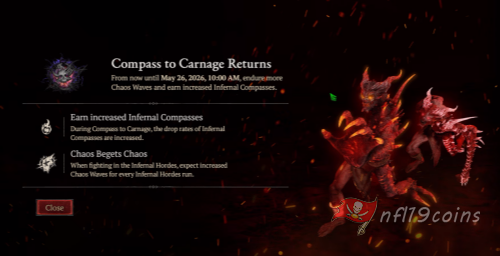
The new Compass to Carnage event, running through May 26, massively increases Infernal Compass drops while also dramatically boosting the appearance rate of Chaos Waves inside Infernal Hordes. That single change may end up transforming the activity from niche seasonal filler into one of the strongest farming methods currently available.
The Hotfix Changes Behind the Event
The event didn’t arrive alone. Blizzard also pushed several impactful class and skill adjustments alongside it.
The biggest nerf targeted the infamous Warlock Eviscerate infinite damage interaction. Players had discovered a bug that allowed effectively limitless damage scaling, completely trivializing high-end content. Unsurprisingly, Blizzard moved quickly to shut it down.
At the same time, Blood Lance also received nerfs, bringing another overperforming setup closer to intended balance levels.
But the most important class change may actually be a buff.
Ball Lightning Sorcerer is officially back.
After several awkward interactions involving skill tags and item scaling, Ball Lightning once again counts as a Core Skill. That matters enormously because many of the strongest affixes, uniques, and multipliers in Diablo 4 specifically scale Core Skills. Before the patch, Ball Lightning players were forced into awkward gearing compromises because several traditionally powerful stats no longer worked correctly with the build.
Now those synergies return.
Winterglass setups regain value. Core Skill scaling matters again. Strike of Stormhorn benefits more naturally from the build path Blizzard originally intended. Even though the tooltip currently may not visually display Ball Lightning as a Core Skill in some situations, the backend calculations reportedly still recognize it properly.
That means one thing: Ball Lightning Sorcerer is once again positioned near the very top of the meta.
Many players already considered it one of the strongest Pit pushing builds in the game, and this update only strengthens that reputation further. With Rogue shadow clone interactions also remaining extremely powerful, Diablo 4’s endgame meta is beginning to settle around a few highly explosive, high-clear-speed archetypes.
Why Infernal Hordes Were Falling Behind
Before this event, efficient players largely ignored Infernal Hordes unless seasonal objectives specifically required them.
The reason was simple math.
A strong build could complete a Nightmare Dungeon in under two minutes. Fast Whirlwind Barbarians, for example, can chain together movement speed bonuses approaching absurd levels while effortlessly clearing elite packs. Tree of Whispers farming routes also remained incredibly rewarding thanks to Grim Favor efficiency.
Infernal Hordes, meanwhile, demanded long multi-wave runs that often stretched close to ten minutes.
Even if rewards were decent, the time investment simply didn’t compete.
That became especially noticeable for players optimizing endgame progression. In action RPGs, efficiency is everything. Every minute matters. Farming routes are constantly compared based on XP gains, loot density, boss material acquisition, and overall progression speed.
Infernal Hordes had fun gameplay—but “fun” alone rarely sustains long-term engagement in a loot-driven ARPG.
Blizzard clearly recognized this problem.
Chaos Waves Completely Change the Formula
The key feature of the Compass to Carnage event is the increased Chaos Wave frequency.
Normally, Chaos Waves feel relatively uncommon. Many players reported seeing roughly one major Chaos Wave per full ten-wave run. During the event, however, the frequency appears dramatically higher.
Some runs are now triggering Chaos encounters nearly every other wave.
That matters because Chaos Waves can explode Aether gains to ridiculous levels.
Instead of finishing a run with average rewards, players are suddenly walking away with 1,500 to 1,800 Aether totals. In some cases, goblin spawns, Hellborne ambushes, or elite-heavy modifiers create enormous loot explosions that dramatically improve the value of the activity.
This fundamentally changes the pacing of Infernal Hordes.
Rather than feeling like a slow grind toward predictable rewards, each wave now carries the possibility of massive payoff spikes. That unpredictability actually makes the mode more exciting while also increasing efficiency.
If the event rates truly hover around a 50% Chaos Wave chance, Infernal Hordes may finally compete with other premier endgame activities.
Barbarian Continues to Dominate Survivability
One major takeaway from current gameplay impressions is just how absurdly durable Barbarian remains.
Immortal-style Whirlwind Barbarian builds continue to trivialize most incoming damage. Players are comfortably standing inside fire waves, ignoring environmental hazards, and face-tanking bosses that would instantly kill squishier classes.
The sheer survivability changes how Infernal Hordes feel.
Instead of carefully navigating dangerous mechanics, high-end Barbarians can focus entirely on maximizing speed and Aether generation. Combined with massive movement speed scaling, the class remains one of the smoothest options for farming nearly every type of content in Diablo 4.
This durability also highlights an important issue in the current balance landscape: some builds are becoming so tanky that enemy AI occasionally appears to stop responding correctly. Monsters often struggle to pressure immortal Barbarians at all, creating encounters where entire waves melt before meaningful combat even begins.
While undeniably powerful, it also reinforces how dominant optimized endgame builds have become this season.
The Butcher Still Feels Over-Tuned
One notable enemy appearance during Infernal Hordes remains controversial: The Butcher.
Even after previous bug fixes addressing inflated health values, many players still feel The Butcher possesses disproportionately massive HP pools compared to other enemies in the activity.
He’s killable, certainly—but the encounter often feels noticeably longer than surrounding waves. When players are measuring efficiency down to the minute, extended boss fights become frustrating quickly.
Still, thanks to improved Chaos Wave rewards, even lengthy Butcher fights may now feel more worthwhile overall.
Infernal Hordes Are Better for Target Farming
The biggest advantage Infernal Hordes may now offer is consistency.
For players hunting specific uniques, boss materials, or crafting resources, the mode is suddenly far more attractive. Increased Aether income means more chest openings, which directly translates into more targeted loot opportunities.
This is especially useful for players farming specific build-enabling items.
Several uniques tied to Infernal Hordes now feel realistically farmable within a reasonable timeframe. Endurance Faith, resource-focused Barbarian gear, cooldown reduction items, and various ancestral crafting bases all become significantly easier to obtain through repeated Horde runs.
The material rewards are also surprisingly solid.
Large Obducite payouts, gem fragments, legendary sigils, and ancestral white items all contribute meaningful long-term value. Even seemingly basic ancestral whites matter because of Diablo 4’s crafting conversion systems.
That means Infernal Hordes are no longer just about immediate gear upgrades—they also support broader crafting progression.
Tree of Whispers Still Competes Strongly
Even with these buffs, Infernal Hordes may not fully dethrone Tree of Whispers farming.
The current Tree event remains extremely rewarding due to its flexibility and efficiency. Players can rapidly chain Grim Favor objectives while simultaneously farming multiple content systems at once, cheap Diablo 4 Gold.
That versatility is difficult to beat.
However, Infernal Hordes now occupy a much healthier position within the endgame ecosystem. Instead of feeling objectively inefficient, they finally offer a compelling alternative for players who enjoy dense combat and high-risk reward spikes.
And honestly, that may be Blizzard’s real goal.
Not every activity needs to become the single best farming method in the game. But every activity should at least feel rewarding enough to justify playing.
Before Compass to Carnage, Infernal Hordes often failed that test.